
Checking Criminal History in Brooklyn
A Brooklyn records search works best when it follows the event instead of relying on one broad name query. Start with a citation, receipt, old report, court notice, or any other paper that names the responding agency. The agency name and report number are stronger locators than a street address alone. If no paper remains, the Brooklyn village office contact channel can help identify whether the village has an administrative record or which public-safety office may hold the incident file.
- Write down the Brooklyn location, date, time range, subject name, and incident or citation number, if known.
- Ask the village office to identify the record holder when the responding law-enforcement agency is unclear.
- Send a narrow FOIA request to the sheriff, Michigan State Police, or other agency that created the report.
- Search the 12th District Court for a misdemeanor or the first stages of a felony, then check 4th Circuit after bindover.
- Use ICHAT for Michigan’s limited public repository history, not as a substitute for the Brooklyn report or court file.
Each step answers a different question. Village files show local government action. Police records describe the incident. Jackson County court records show filed charges and outcomes. ICHAT shows only the public part of qualifying history sent to Michigan State Police.
Brooklyn Village or Sheriff Records
Brooklyn village records and sheriff records are not interchangeable. The village may hold council minutes, ordinances, permits, correspondence, or other government documents. It should receive a request for a record it made or retained. A sheriff incident report, arrest report, booking sheet, or jail record belongs with Jackson County. A Michigan State Police report stays with MSP. The village profile did not verify a current Brooklyn police records unit or police portal, so a requester should not assume village hall owns every record tied to a Brooklyn address.
The official Village of Brooklyn site shows the local government entry point.
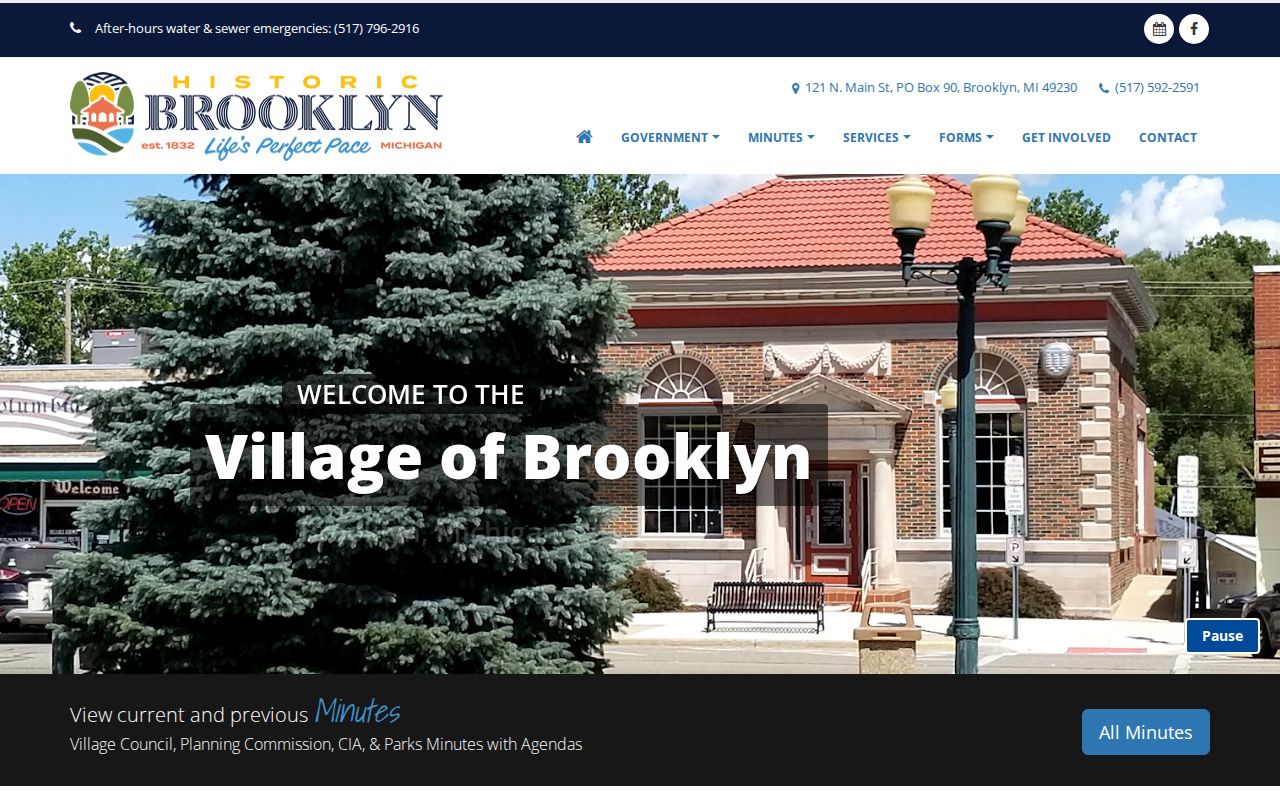
That official page is useful for village business, but the creating law-enforcement agency remains the right source for an incident narrative.
A short call can prevent a misdirected request. Ask who responded, whether Brooklyn holds any responsive document, and which agency should receive the police-record request. A “no responsive record” answer from village hall means only that the village did not locate a record in its custody. It does not prove that no call, report, booking, or case exists elsewhere.
Brooklyn Police Department Records
No current official Brooklyn police records unit, public police portal, or village police app was verified in the research. That finding changes the search path. Do not look for a generic “Brooklyn Police Department” database or send sensitive incident details to an unverified service. Instead, identify the agency shown on the ticket, report number, dispatch paperwork, or Jackson County court entry. In and around Brooklyn, the responding holder may be the Jackson County sheriff, Michigan State Police, or another serving agency.
Once the holder is known, describe the record with care. Include the Brooklyn location, a useful date and time range, the incident or agency report number, the type of record sought, and a preference for electronic delivery. Ask for the incident report, arrest report, dispatch record, or other named item rather than “everything.” A focused request helps the agency locate the file and limits review of material that may be exempt.
Michigan FOIA can allow an agency to redact active-investigation details, juvenile information, victim identifying data, medical material, and other protected content. A partial release may still provide the nonexempt parts of a Brooklyn record.
Call Brooklyn to Find the Holder
When no report number or agency name is available, Brooklyn’s published village phone number, 517-592-2591, is a practical first step. The goal is not to ask village staff to run a criminal-history search. Ask a narrow routing question: does the village hold the named administrative record, or can staff identify which agency would have answered an incident at the stated Brooklyn place and time?
The Brooklyn contact page documents the village communication route.
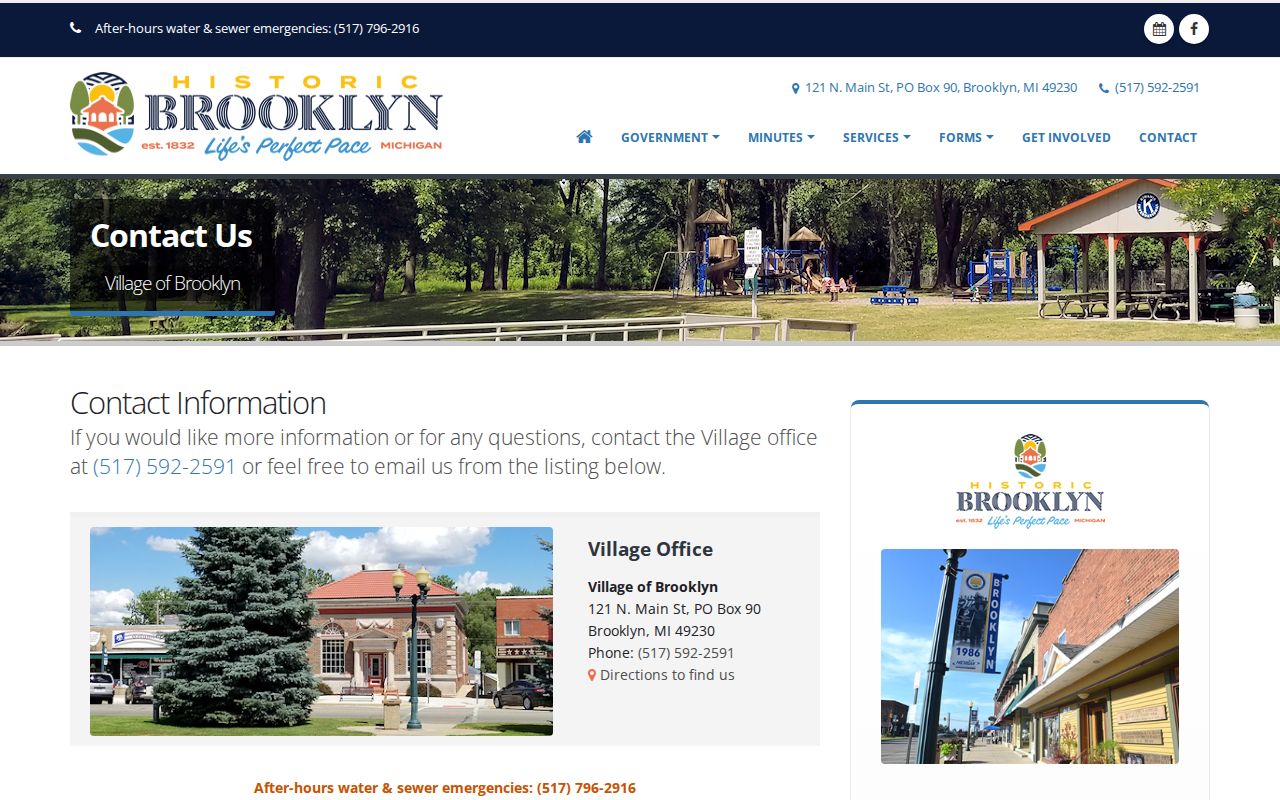
The contact page supports holder identification, while the actual criminal record request must go to the public body that keeps the file.
Have a compact fact set ready before calling. Use the street or site within Brooklyn, date, time window, names as they appeared on the event record, and the record class needed. If staff names the sheriff or MSP, confirm the agency name and preferred request channel. This approach is more reliable than treating an empty village search as a final result.
Brooklyn Arrests and Bookings
Brooklyn has no verified village booking facility or public booking log. A person arrested after a Brooklyn incident ordinarily enters the county-level custody chain. Jackson County Corrections is the direct official route for present custody confirmation after intake. The sheriff’s office can also receive a narrow FOIA request for a booking face sheet, arresting-agency identity, charge and bond list, release entry, or booking photo if that item is releasable. No dependable public Jackson County inmate-name roster was found.
The sheriff's booking and jail history overview provides local context for intake and classification after a Brooklyn arrest.
A booking record is only a snapshot. It may show the arresting agency, intake time, holding charge, bond, court, holds, and release status. The prosecutor can later authorize different charges, and the court can amend or dismiss a count. For a deeper county-wide explanation, the Jackson County arrest lookup details the official custody and agency channels.
Use 12th District Court after arraignment to see what was filed. Very recent Brooklyn activity may not appear there at once. ICHAT is even less useful for a new arrest because it is not a live booking log and excludes warrants.
Brooklyn’s 1,206-Person Record Route
Brooklyn ranked second among Jackson County’s incorporated places in the 2020 Census, with 1,206 residents. Its small size does not create a smaller version of every county justice office. Instead, village, county, and state bodies divide custody by record type. That division is why a Brooklyn address can lead to a village administrative file, a sheriff or MSP incident record, a county booking, two possible county court levels, and a qualifying statewide ICHAT entry.
The city name can be a useful search clue, but it does not decide ownership. The responding badge and court level do. This distinction matters for older events, when a person may remember “Brooklyn police” as a broad phrase but the official report was made by another agency. Search the court docket by legal name or case number, then use the displayed agency and case data to sharpen a report request.
Brooklyn’s “Heart of the Irish Hills” identity is meaningful local context, yet it is not a database label. Searches should still use the formal court and agency fields recorded at the time of the event.
Municipal Court Records in Brooklyn
Brooklyn does not have a verified municipal criminal court or village case-search system. Ordinance, misdemeanor, traffic, and early felony matters that become criminal cases route to Jackson County’s 12th District Court. A felony that passes the preliminary stage moves to the 4th Judicial Circuit Court after bindover. Village ordinance pages, meeting archives, and tax tools do not replace either court docket.
| Court Name | 12th Judicial District Court; 4th Judicial Circuit Court after felony bindover |
|---|---|
| Case Types Heard | District handles misdemeanors and preliminary felony stages; circuit handles bound-over felony cases |
| Case Lookup Channel | Jackson Courts Docket and MiCOURT participating-court search, plus the appropriate clerk |
| What the Docket Shows | Court, case number, filing date, charges, register entries, hearings, status, and public dispositions |
| Copies & Fees | Request documents or certified dispositions from the clerk; current copy and certification charges control |
Search 12th District first for a Brooklyn misdemeanor or a felony’s arraignment, probable-cause conference, and preliminary examination. Search 4th Circuit when the district register shows bindover. A filing, hearing, or bindover is not a conviction. Read the final result for each charge.
Search Brooklyn District Court Records
The 12th District Court information page is the official county route for calendars, records links, and court services used by Brooklyn cases.
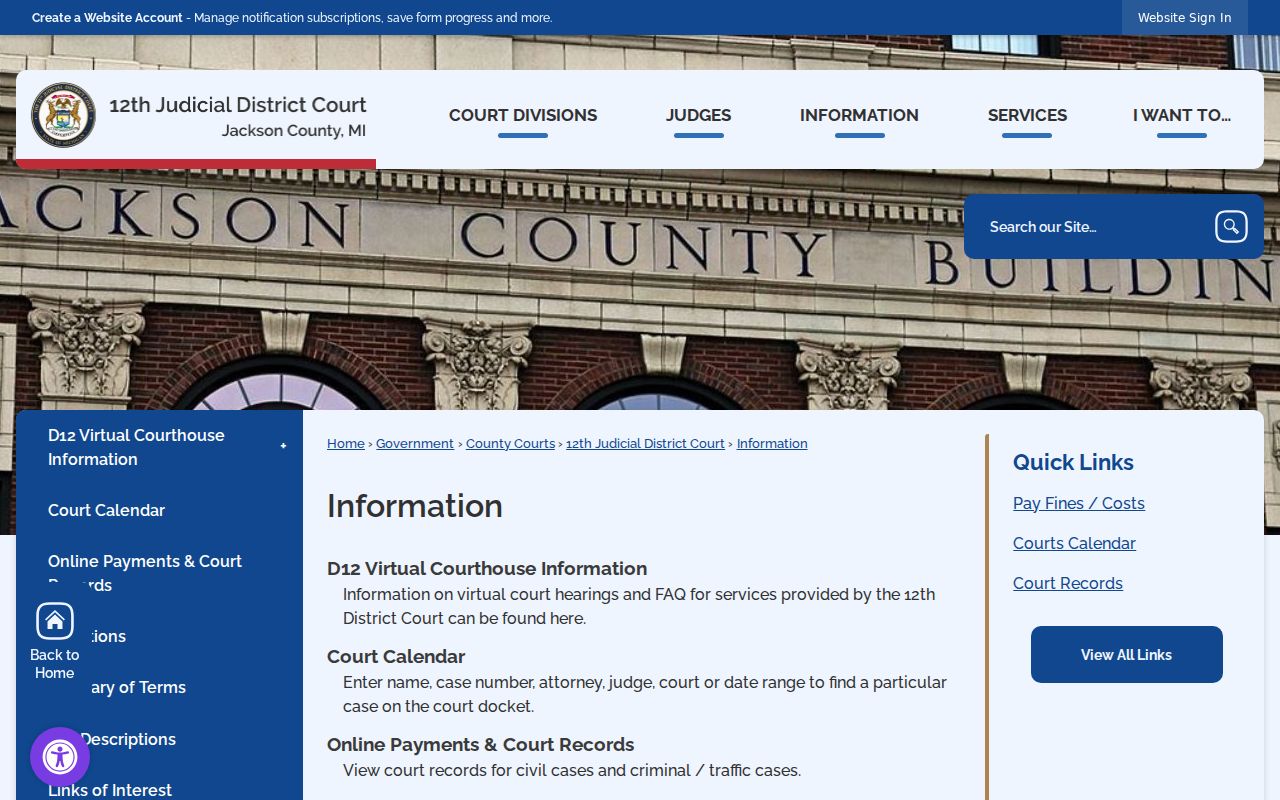
This county screen shows why a Brooklyn criminal case search belongs in the district or circuit system, not in a village property or meeting portal.
Choose the Jackson court before entering a party name or case number. The public case view may include the case type, filing date, party role, charge description, statute, status, hearing schedule, register of actions, disposition, bond, and financial fields. Document images vary. Request the complaint, register of actions, judgment, sentence, or certified disposition from the clerk when the online view is not enough.
Older Brooklyn cases may need a clerk search or archive retrieval. Give the clerk the court level, approximate year, name, and any case number found in other records. That is more precise than asking village staff for an old criminal file they never held.
Where Brooklyn Records Go
Brooklyn records move according to function. The responding agency creates the incident or arrest report. Jackson County Jail creates a booking file after intake. The prosecutor and 12th District Court create the charging and early case records. A bound-over felony receives a 4th Circuit file. Qualifying fingerprint-supported arrest and disposition data can reach the Michigan State Police Criminal Justice Information Center for the public ICHAT product.
Record flow: Serving law-enforcement agency › Jackson County Jail › 12th District Court › 4th Circuit after bindover › Michigan State Police CJIC
The systems update on different schedules and show different facts. A Brooklyn police narrative can remain even if the court dismisses a charge. A jail record may use the holding charge, while the court shows the prosecutor’s filed count. ICHAT can omit minor local matters, warrants, juvenile cases, traffic matters, suppressed records, and out-of-state or federal records.
For self-review, compare the source report with the charge-level court outcome. If ICHAT does not match a certified disposition, correct the sentencing court first when its record is wrong, then follow MSP’s update process.
Brooklyn Village FOIA or Police FOIA
The right FOIA recipient depends on custody, not geography. Send a Brooklyn village request for village-created administrative records. Send a law-enforcement request to the sheriff, MSP, or other agency that made the report. The Jackson County FOIA page provides the official request route for sheriff-held material.
The county channel is appropriate for sheriff records, but it does not transfer ownership of an MSP or village document to Jackson County.
Michigan FOIA generally calls for a response within five business days and allows one written extension of up to ten business days. The response can grant, deny, partly grant, quote a fee or deposit, or extend the response time. It does not always mean a large file will be delivered within five days. Ask for electronic copies and reasonably segregable nonexempt portions. A clear Brooklyn location, date range, record type, and incident number can reduce search time.
Finding Older Brooklyn Criminal Records
An older Brooklyn matter may have less useful online detail. Begin with any surviving case number, incident number, citation, date, or agency name. Search both Jackson court levels when a felony may have moved after bindover. If the public docket is incomplete, ask the 12th District or 4th Circuit clerk for an archive search and name the document needed. A certified disposition is the best court proof of how a charge ended.
For the incident side, ask the identified law-enforcement agency about its retention and archive process. Records can be withheld or redacted when the law protects juvenile, victim, medical, investigative, or personal information. Village meeting archives may help with the history of a local policy or ordinance, but they are not a substitute for an individual criminal case file.
ICHAT can help with qualifying public Michigan history, though it is not a full archive of every Brooklyn event. OTIS applies only when state prison, felony probation, or parole is relevant, and it generally stops public display three years after discharge.
Public Access Rules in Brooklyn
Public access changes with the custodian. Executive-branch records held by Brooklyn, the sheriff, or MSP use Michigan FOIA and its exemptions. Jackson court files are governed chiefly by Michigan Court Rule 8.119 and clerk procedures rather than FOIA. ICHAT dissemination follows the state criminal-history statutes. Set-aside, sealed, juvenile, victim, medical, and active-investigation material may be excluded or redacted.
Key Statutes:
Michigan Freedom of Information Act, MCL 15.231 et seq. gives access to public-body records while allowing lawful exemptions, fees, and redaction.
MCL 28.241a and 28.243 govern Michigan State Police criminal-history maintenance and public dissemination limits.
Michigan Court Rule 8.119 governs court-record access, copies, retention, and nonpublic material.
A search with no Brooklyn result must be stated with care. It means no matching public record was found in that system under those terms. It is not proof that no incident, booking, case, sealed matter, or record in another jurisdiction exists.